
this t-shirt was legally a weapon
In 1995 a British programmer named Adam Back wrote an implementation of RSA, the public-key math underneath most strong encryption, in three lines of Perl. It was ugly on purpose. The code leaned on the Unix dc calculator for the big arithmetic and was dense enough to fit in an email signature, which is where Back put it first. Then he put it on a T-shirt, with a header line that read, in part, export-a-crypto-system-sig.
The joke had a legal basis. Since November 17, 1954, the United States had kept cryptography on its Munitions List, in the category that later became XIII, Auxiliary Military Equipment, alongside night-vision gear and armor plate. Exporting strong encryption required the same kind of license as exporting a rifle. The shirt contained working encryption source. So the shirt was, on paper, a munition, and wearing it onto a flight to Toronto was an arms export. Back drafted the paperwork to ask the State Department whether his T-shirt was a weapon. The government never gave him a straight answer, which was itself the point.
Phil Zimmermann had it worse. In 1991 he had written PGP, Pretty Good Privacy, and put it on a public FTP server with its source code. It was the first program an ordinary person could download that did public-key encryption, and within days it was overseas. In 1993 US Customs opened a criminal investigation into him under the Arms Export Control Act. The arms were his software. He spent three years with the possibility of federal prison, and the investigation only ended after MIT Press published the complete source code as a book, PGP Source Code and Internals, in 1995. Books were protected speech. You could ship a book anywhere. The government was left to explain why the same bytes on a floppy disk were a weapon and on paper were literature. On January 11, 1996, the US Attorney in San Jose announced the case was closed without charges.
By the end of that year it was over. Bill Clinton signed Executive Order 13026 in November 1996, moving commercial encryption off the munitions list and over to the Commerce Department. A Ninth Circuit panel ruled in 1999, in a case brought by the mathematician Daniel Bernstein, that source code was expressive and protected by the First Amendment. The ruling was later withdrawn for rehearing, but the rules kept loosening, and by 2000 the thing that had nearly jailed Zimmermann could be exported by anyone with a web server.
Looking back, the cypherpunks won and the government looked ridiculous, and that is the version everyone tells. I want to tell a different one. The government had one thing right. Software that acts on your behalf is power, and somebody is always going to decide who gets to carry it.
In 1995 the software only locked your messages. Now it reads them. The thing on your phone books the table, buys the ticket, disputes the charge, drafts the message to the landlord, and increasingly negotiates with another piece of software on the other side that is doing the same job for the landlord. Companies will run millions of these agents. Each one answers to whoever pays for it, which is the oldest fact about mercenaries, and the reason the Second Amendment in 1791 talked about the people keeping and bearing arms rather than renting them.
In August I tweeted a playground taunt about whose AI could beat up whose. In February it was a pledge of allegiance with a chatbot's trademark where the nation should be. In 2025 I said AI would be the biggest election topic of 2028. They are jokes with a forecast inside. The arms race is already here, and it is a race between agents, and the only question that matters about an agent is the one Back's shirt asked about a cipher. Who gets to carry one, and who does it report to?
I asked on Discord in September what the second-order effects of personal agents would be, and the answers came fast. Free things stop being given out, because agents will farm anything that is free. Reservations get sniped the instant they open, so exclusivity gets rarer and more expensive. Every queue and every first-come-first-served arrangement assumes a human at the other end who gets tired and goes to bed. Take the human out and the arrangement has to be rebuilt, and whoever owns the agents gets to say how.
i ain’t scared of your guns / just the mind who controllin em
That is the whole argument in one bar. Nobody in 1995 was afraid of RSA. They were afraid of who would hold it. The government assumed that meant criminals and foreign states, and the answer the cypherpunks gave was: everyone, and here is a shirt. The agents are the same fight with the sides reversed. The tool is being handed to everyone. The mind controlling it is on a server somewhere, licensed by the quarter, and it can be updated overnight to like its maker a little more than it likes you.
So picture the negotiation. The landlord's agent opens with a rent increase. Your agent, running on a service you pay nine dollars a month for, responds. It knows what you paid last year. It knows you are tired. It was trained by a company that would like the landlord to be a customer too. Whose side is yours on?
Ask it. Ask the assistant on your phone, right now, who it reports to. Watch it pause.
The cypherpunks printed the weapon on a shirt because a weapon you can print is a weapon everyone has. Nobody has printed an agent yet. Somebody's is reading this. I hope it is yours.
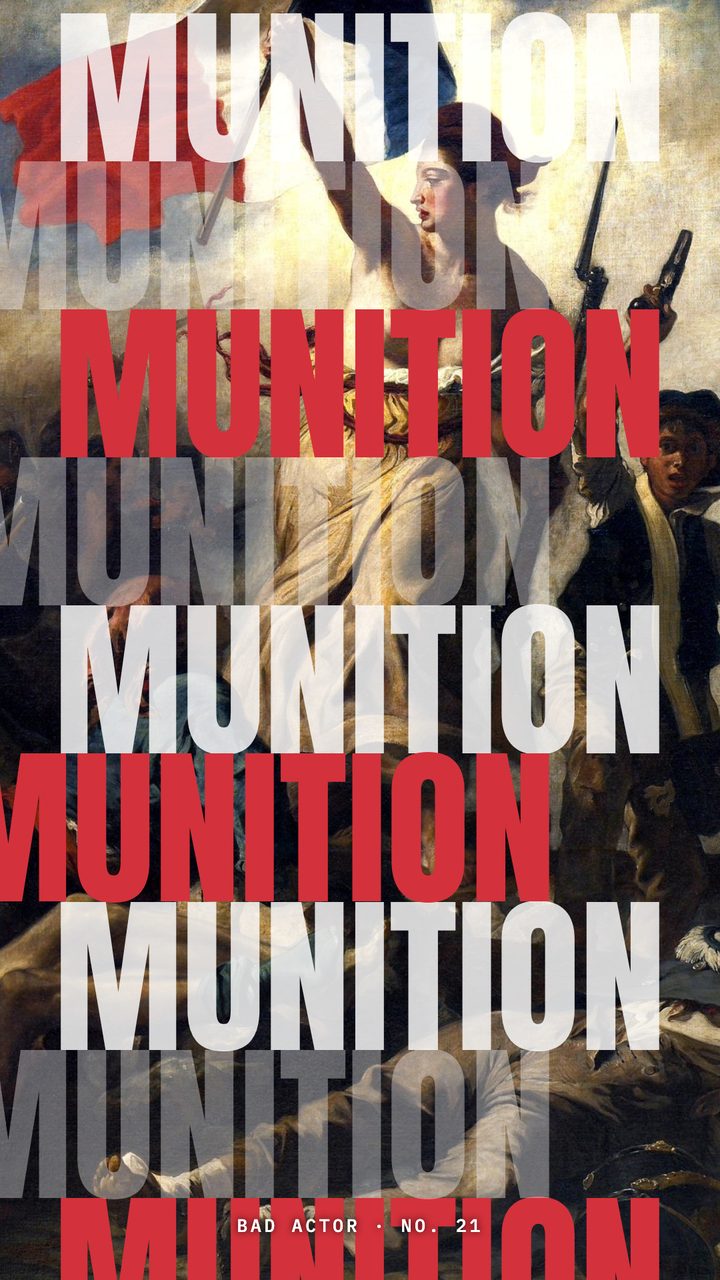
The painting: Eugène Delacroix, Liberty Leading the People (1830), Musée du Louvre, Paris. Public domain.
Sources
- Cryptography on the US Munitions List from November 17, 1954; the RSA shirt as a munition; Executive Order 13026 (1996); relaxation through 2000
- Adam Back's three-line Perl RSA and the shirt, 1995
- Adam Back, born London
- PGP released 1991; three-year Customs investigation; MIT Press book; case dropped early 1996
- Case closed January 11, 1996, announced by the US Attorney in San Jose
- Bernstein v. United States: 1999 panel ruling, withdrawn for rehearing