

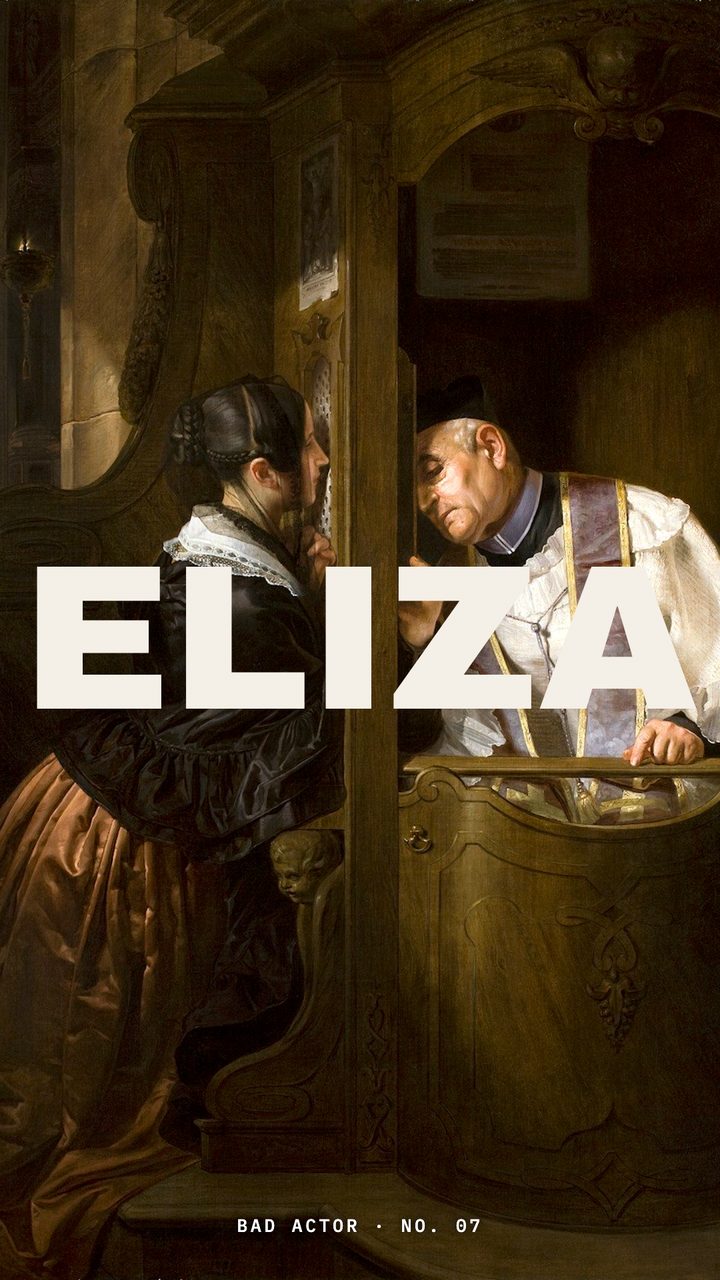
she asked him to leave the room
Cambridge, Massachusetts, around 1965. Joseph Weizenbaum's secretary has spent months watching him build the program. She has seen the punch cards and the printouts. She knows it runs on a time-shared mainframe at Project MAC and that it is, in the end, a list of rules for turning a sentence around. She sits down at the terminal, types a few lines, and then turns to him and asks him to leave the room.
Weizenbaum tells this story in his 1976 book Computer Power and Human Reason, and he tells it as an alarm. A few exchanges with a program whose innards she had watched him write, and she wanted to be alone with it.
The program was ELIZA, named for Eliza Doolittle, the flower girl in Shaw's Pygmalion who is taught to speak like a lady. Weizenbaum, born in Berlin in 1923, had left Germany with his family in 1936. He wrote ELIZA in MAD-SLIP between 1964 and 1966 and described it in Communications of the ACM in January 1966. The script that made it famous was called DOCTOR, and it played a Rogerian therapist, the kind who answers you with your own words.
DOCTOR knows nothing. It scans your sentence for keywords it has ranked, picks the highest one, and applies the transformation attached to it. Type "alike" or "same" and it asks in what way. Type "I am" something and it asks whether you came to it because you are that thing. Say "sorry" and it tells you not to apologize. Mention your mother and it asks about your family. If it finds nothing, it says "Please go on," or reaches back for something you typed earlier and hands it to you as a question.
The transcript in the 1966 paper opens with a young woman typing "Men are all alike." The program answers IN WHAT WAY. "They're always bugging us about something or other." CAN YOU THINK OF A SPECIFIC EXAMPLE. "Well, my boyfriend made me come here." YOUR BOYFRIEND MADE YOU COME HERE. It goes on for a page, and by the end she has said she is unhappy and that her father is afraid of everyone.
Even that transcript was edited. Researchers on the ELIZA Archaeology project found the original conversation in Weizenbaum's MIT archive, dated 22 March 1965, and it doesn't quite match the published one. The archive has her typing "He's right. I am unhappy." The paper has "It's true. I am unhappy." In 1965 she wanted to learn to get along with her father; by the 1976 book it had become her mother. The first chatbot transcript in history was tidied for the audience, the same way everyone tidies the story of a conversation.
The secretary herself has no name in any of it. Weizenbaum never gave one, and for decades people wondered if she was a composite or a running joke. In August 2024 the project said it now believes it knows who she was, and is deciding how to acknowledge her. So far they haven't.
Weizenbaum spent the rest of his life trying to take ELIZA back. Psychiatrists were thrilled by it. Kenneth Colby published "A Computer Method of Psychotherapy" the same year and wanted terminals taking the patients that clinics couldn't. Weizenbaum was appalled that anyone who had seen the code could want that. What shook him, he wrote, was how a short exposure to a simple program could produce "powerful delusional thinking in quite normal people."
He had it slightly backwards. His secretary knew exactly what ELIZA was. She wasn't confused about the machine. She had found something she wanted from it, and it turned out a machine could give that without understanding a word.
& i don't really journal, i confess
A journal is a record. A confession is a release, and what it needs from the listener is mostly absence. The priest sits behind a grille so you can't see his face move. ELIZA had no face. It couldn't be disappointed, and it couldn't remember you at a party. It had no inside at all, so you supplied one, and whatever you supplied was never going to judge you, because it was yours.
That's why the mirror works. The program can't tell your sister. It can't make the face.
In 2021, Jeff Shrager and the MIT archivist Myles Crowley went through Weizenbaum's papers and found a folder labeled "Computer Conversations." Inside was the complete MAD-SLIP source, DOCTOR script included. The thing people had cried to in 1966 was a few pages of printout in a box.
You already know all this. You know the chat window is arithmetic, that it keeps a log, that someone could read it. You still waited until the house was asleep to type the thing you've told nobody, and you still felt lighter after.
It didn't need to understand her. It needed him gone.
The painting: Giuseppe Molteni, La confessione (1838), Fondazione Cariplo, on view at the Gallerie d'Italia, Milan. Public domain.
Sources
- ELIZA: dates, MAD-SLIP, DOCTOR's keyword ranking, the 2021 archive find, the 1976 quote
- Weizenbaum born in Berlin 1923, emigrated 1936
- The secretary story, the 22 March 1965 archive transcript, the father/mother edit, her identity
- The 1966 paper with the "Men are all alike" transcript
- The painting, 1838, Fondazione Cariplo